
Best Budget Baby Carriers of 2026
Five carriers under $60 that hold up against carriers twice the price — no insert needed on any of them.
The best budget baby carriers prove you don’t need to spend $150–$250 to get an ergonomic, hip-healthy carrier. Our top pick, the Infantino Flip 4-in-1, covers four carry positions from about 8 to 32 lbs for around $40. If you want the closest thing to a wrap without any tying, the Baby K’tan Original pulls on like a t-shirt for $49.99.
Our 5 picks for the best budget baby carriers

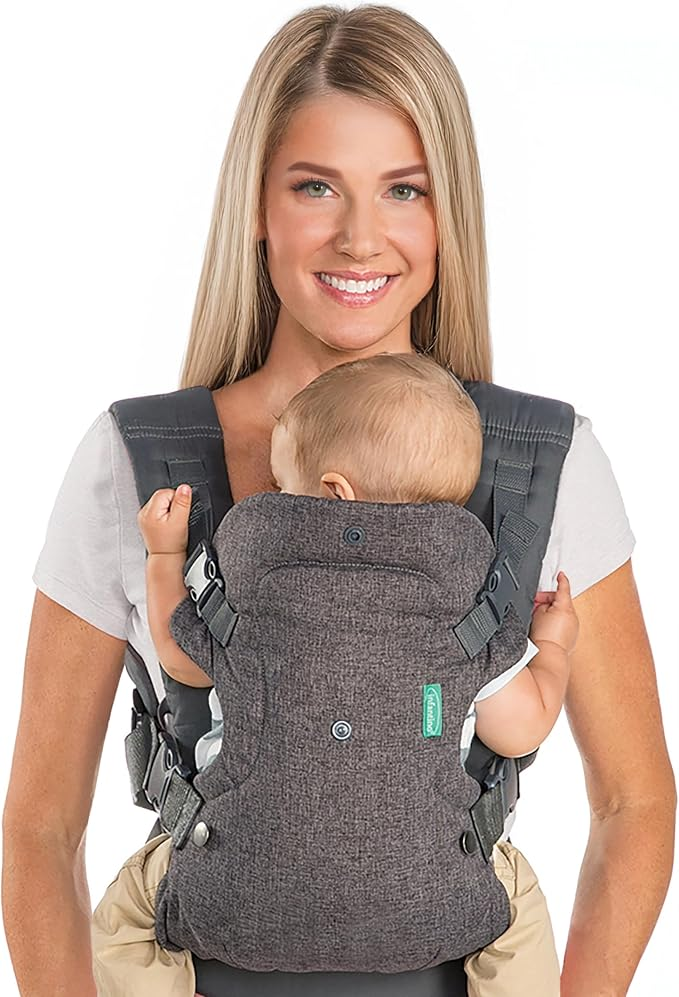
Infantino Flip 4-in-1 Convertible Carrier
Four carrying positions and a genuine newborn-to-toddler range for under $40 — the widest feature set of any carrier on this list at this price.
Why this one: The Flip adjusts between a folded, narrower seat for smaller babies and an expanded seat as they grow, covering four carry positions without paying for premium materials. It’s consistently one of the best-selling and best-reviewed carriers on Amazon regardless of price.
Skip it if: you want back-carry support before 8 lbs, or you want mesh/premium fabric — the Flip uses standard woven cotton, which runs warmer than mesh carriers on this list.

Baby K’tan Original
A pre-shaped wrap you pull on like a t-shirt — the closest thing to a wrap carrier’s snug fit without any tying or buckles.
Why this one: Baby K’tan skips buckles and rings entirely: you step into a double-loop of soft cotton fabric sized to your body, then slide baby in. It’s IHDI hip-healthy certified and popular with parents who found wrap-tying intimidating but still want that close, wrap-style fit.
Skip it if: you don’t want to order a specific size. Unlike buckle carriers, the K’tan is sized to the wearer’s body (XXS–XL), so you need to check the size chart before ordering rather than relying on one-size-fits-most adjustability.

MOBY Duet Carrier
An adjustable waistbelt and seat that reshapes for different-sized babies and different-sized parents, so two caregivers can share one carrier comfortably.
Why this one: The Duet’s seat adjusts from wide to narrow and the waistbelt fits a broad range of body sizes, which makes it a practical pick for households where more than one adult will be wearing the carrier. Soft, breathable cotton and removable drool pads round it out.
Skip it if: you want a fourth carry position like back carry — the Duet covers front-facing-in (two widths) and front-facing-out only.

Momcozy PureHug
A wider weight range than most budget carriers, plus the option to step up to a breathable mesh version if you’re in a hot climate.
Why this one: PureHug’s X-shaped back strap design distributes weight more evenly than a straight two-strap setup, and at 7–45 lbs it covers newborn through toddler in one carrier. The base cotton version is the budget pick; an air-mesh version is available for about $20 more if summer heat is a concern.
Skip it if: you want the absolute lowest price on this list — it’s the most expensive “budget” pick here, though still well under premium carrier pricing.
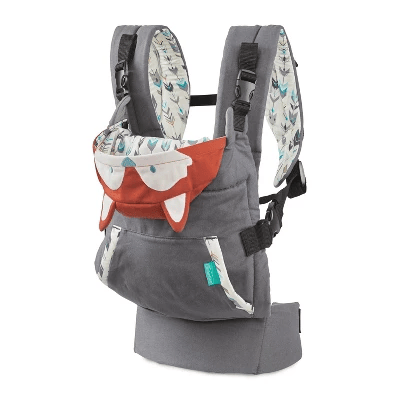
Infantino Cuddle Up Ergonomic Hoodie Carrier
A knee-to-knee ergonomic seat with a removable character hood, built for front or backpack-style back carry once baby is old enough.
Why this one: Once your baby outgrows a newborn-only carrier, the Cuddle Up offers real back-carry support at a budget price, with a wide ergonomic seat and a padded waist belt that shifts weight to your hips. The removable hood keeps a sleeping baby’s head supported without a separate infant insert.
Skip it if: you need it from birth — the 12 lb minimum means this isn’t a newborn carrier, so pair it with a cheaper wrap for the first couple of months if needed.
How to choose a budget baby carrier without sacrificing safety
- Confirm it meets the same safety standard as premium carriers. In the US, soft carriers are tested to ASTM F2236 regardless of price — a $40 carrier and a $250 carrier both have to meet it. Check the product listing or manual for this standard.
- Look for hip-healthy positioning. Budget doesn’t mean skipping the M-position. Look for the IHDI hip-healthy seal or a manufacturer claim of ergonomic, knee-to-knee seating.
- Check the weight range against your timeline. Some budget carriers (like wrap-style options) start lower and stop earlier; others stretch further into toddlerhood. Buying for the full range you need avoids a second purchase.
- Decide how many carry positions you actually need. A 4-position carrier costs more to manufacture than a 2-position one, but if you only ever use front-carry, you’re not losing anything by choosing a simpler, cheaper option.
- Factor in fabric weight for your climate. Budget carriers are usually 100% cotton, which runs warmer than mesh. If you live somewhere hot, a slightly pricier mesh version (like PureHug’s air-mesh option) may be worth the extra $15–20.
Do cheaper baby carriers meet the same safety standards?
Yes — in the United States, soft-structured carriers, wraps, and slings sold at any price point are required to meet ASTM F2236, the consumer safety standard covering structural integrity, buckle strength, and labeling. A $40 carrier from a mainstream brand and a $250 carrier are held to the same baseline. Price differences mostly come down to fabric (cotton vs. mesh), number of carry positions, adjustability range, and brand extras like storage pockets or removable hoods — not core safety. The five picks above are the best baby carriers for newborns and toddlers on a budget precisely because they combine that baseline safety with genuinely useful features, not stripped-down basics — which is exactly why they earned a spot among the best budget baby carriers on this list. For more on safe positioning at any price, see the International Hip Dysplasia Institute’s babywearing guidance.